
Loft Conversions
Turn your unused loft into a stunning bedroom, home office, or playroom. No need to extend your footprint — the space is already there.
The Space You Already Own
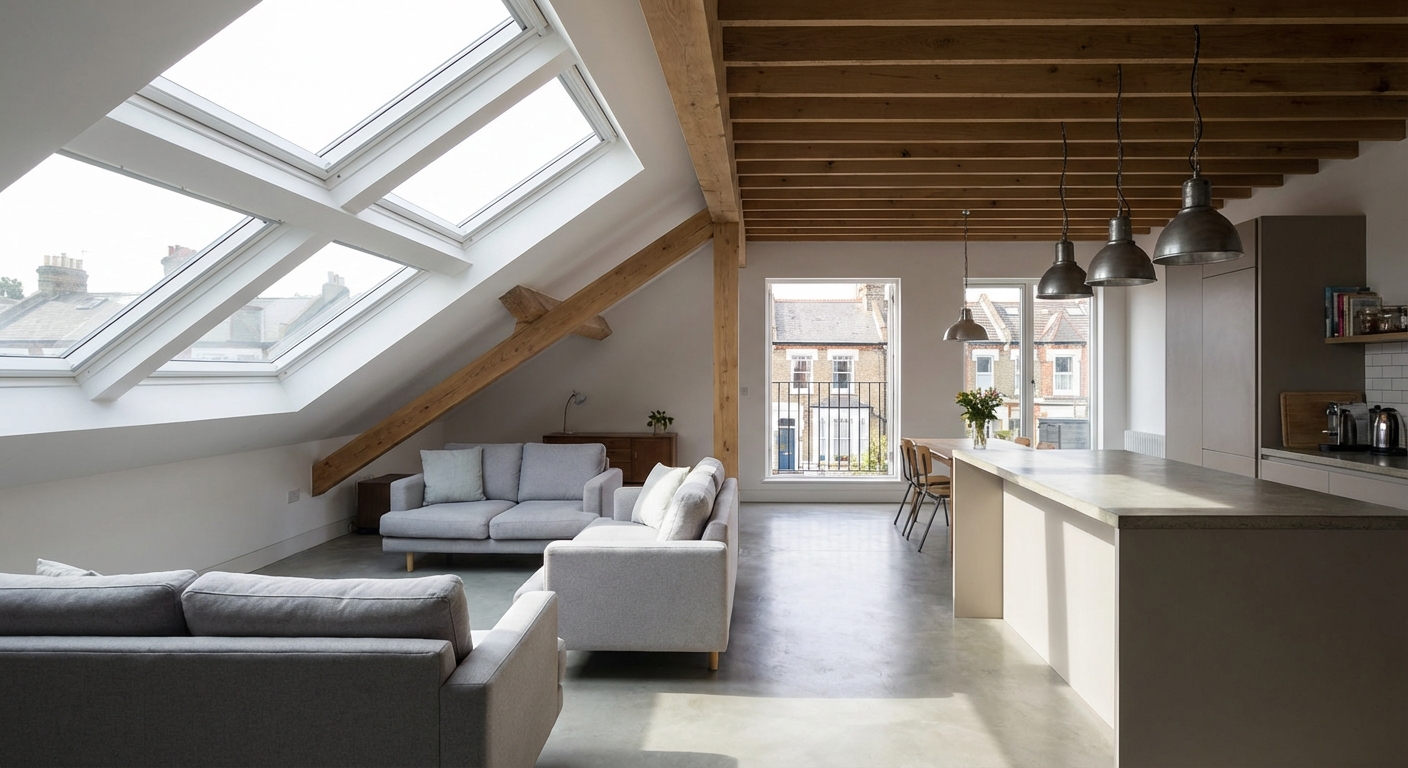
Your loft is probably the biggest unused room in your house. Most UK homes have enough roof space to create a generous bedroom with an ensuite, a home office with room to breathe, or a self-contained kids' zone that gives the rest of your home back to the adults.
A loft conversion is consistently one of the smartest investments a homeowner can make. You're not buying extra land, you're not eating into your garden, and in most cases you don't even need planning permission. The structural work is contained within the existing building envelope, which means less disruption than a ground-floor extension and typically a faster build.
We carry out loft conversions across the UK, from Victorian terraces in London to 1930s semis in Manchester, Birmingham, and Leeds. Each property has its own characteristics — roof pitch, ridge height, chimney positions, water tank locations — and we work with what's there to maximise your usable space.
Is Your Loft Suitable?
The single most important factor is head height. You need at least 2.2 metres from the top of the ceiling joists to the underside of the ridge beam at the highest point. Grab a tape measure and check — if you're close to or above this figure, you're in good shape.
If your roof has traditional cut-timber rafters (individual timbers running from the ridge to the eaves), conversion is straightforward. If you have trussed rafters (factory-made W-shaped frames), the trusses need to be removed and replaced with a new structural framework — it's doable but adds £5,000–£10,000 to the cost.
Other factors we assess: the roof pitch (steeper is better — 35° or more is ideal), the position of the soil stack and water services, chimney breast locations, and whether the existing first-floor structure can support the new staircase opening. We check all of this during our initial survey before giving you a quote.
Most homes built from the 1930s onwards have suitable lofts. Pre-1900 properties often have excellent ridge heights but may need more work on the floor structure due to the age of the timbers.
Types of Loft Conversion
The right type depends on your roof structure, your budget, and how much space you need. Here's what we build most often.
Velux / Rooflight Conversion
The simplest and cheapest option. We strengthen the floor, install roof windows (Velux is the best-known brand), add insulation, a staircase, and fit out the room. The roof shape stays exactly as it is — no dormers, no structural changes to the rafters. Works well if you already have good head height (2.4m+) and a steep roof pitch. Limited usable floor area compared to dormer options because the sloping ceilings eat into the edges of the room. Ideal for bedrooms and offices where you don't need to stand at every point.
Rear Dormer Conversion
The most popular type in the UK. A flat-roofed dormer is built out from the rear roof slope, creating a box-shaped extension at roof level with a vertical back wall and full-height ceiling across the width of the house. This dramatically increases the usable floor area — you go from a triangular cross-section to a rectangular one. The rear dormer is the workhorse of loft conversions and typically falls under permitted development provided it doesn't exceed 40m³ (terraced) or 50m³ (detached/semi).
Hip-to-Gable Conversion
If your house has a hipped roof (the roof slopes down on the side as well as front and back), the hip section significantly reduces the usable loft space on that side. A hip-to-gable conversion extends the side wall vertically up to the ridge, replacing the sloping hip with a flat gable end. This is common on 1930s semi-detached houses where the hipped side faces away from the neighbour. Often combined with a rear dormer for maximum space. Adds roughly £8,000–£12,000 over a standard dormer.
Mansard Conversion
The most extensive (and expensive) type. The entire rear roof slope is rebuilt at a near-vertical angle (72° is typical) with a flat roof on top. This creates maximum internal volume and often allows for a full second bedroom or bathroom that wouldn't fit in a standard dormer. Mansard conversions almost always require planning permission because they significantly alter the roof profile. Common in London's Victorian terraces where property values justify the higher build cost. Build time is 10–12 weeks.
L-Shaped Dormer
Combines a rear dormer with a side dormer to create an L-shaped roof extension. Used on properties where the main rear dormer alone doesn't provide enough space — typically because the roof is narrow or the ridge is low. The side element sits over the original side wall and wraps around the corner. More complex structurally and usually needs planning permission, but creates a spacious loft that can comfortably accommodate two rooms plus a bathroom. Costs £50,000–£70,000 depending on size.
Modular / Prefabricated Dormer
The dormer is built off-site in a factory and craned into position in a single day. The rest of the conversion (floor, staircase, fit-out) proceeds normally. The main advantage is speed — the weathertight shell is up in hours rather than weeks, reducing exposure to weather damage and cutting on-site disruption. Currently available mainly in the South East but expanding nationwide. Costs are comparable to traditional dormer builds, sometimes slightly higher due to crane hire and transport.
Loft Conversion Costs in 2026
These prices cover the full conversion: structural work, insulation, staircase, electrics, plastering, and basic decoration. Bathroom fit-out, bespoke joinery, and high-end finishes are additional.
Velux / Rooflight
£25,000 – £35,000
No structural roof changes. Includes floor reinforcement, 2–3 Velux windows (£500–£1,000 each installed), insulation to current Part L standards, staircase, electrics, plastering, and fire door. The most cost-effective route if your existing roof shape gives you enough head height.
Rear Dormer
£35,000 – £55,000
Full-width rear dormer with flat or slightly pitched roof. Includes steelwork (ridge beam, purlins), dormer construction, lead or GRP flashings, new windows, floor reinforcement, staircase, insulation, electrics, and plastering. Scaffolding is typically £1,500–£3,000.
Hip-to-Gable + Dormer
£45,000 – £65,000
Gable end wall built up in blockwork or timber frame, existing hip rafters removed and ridge extended to the new gable. Rear dormer then built as above. This combination gives the most space on semi-detached houses. Structural steelwork is more involved — budget an extra £2,000–£4,000 for the engineer and steel.
Mansard
£55,000 – £80,000+
Complete rear roof rebuild. Requires planning permission, detailed architectural drawings, and often a party wall agreement. The most disruptive conversion type — the rear roof is entirely stripped and rebuilt. But the result is maximum space with near-vertical walls. In London, mansard conversions routinely exceed £80,000 due to labour costs and planning complexities.
Common Extras That Affect Price
Ensuite bathroom: £4,000–£8,000
Includes plumbing, tiling, shower/WC/basin, and ventilation. Wet rooms with tanked floors cost more but work well in tight spaces.
Juliet balcony: £1,200–£2,500
Full-height glazed doors with a glass or metal balustrade. Lets in massive amounts of light without needing planning for a full balcony.
Built-in storage: £1,500–£4,000
The eaves areas (where the ceiling slopes down to the floor) are perfect for built-in wardrobes and shelving. Bespoke joinery makes the most of every inch.
Staircase upgrade: £1,000–£3,000
Standard regulations-compliant staircase included in the base price. Upgrade to oak, glass balustrade, or a space-saving spiral for extra.
Planning Permission & Building Regulations
Permitted Development
Most loft conversions fall under permitted development (PD) and don't need a planning application. The key conditions are:
Volume allowance: The dormer and any other roof additions can't exceed 40 cubic metres on a terraced house or 50 cubic metres on a detached or semi-detached. This volume is measured externally.
No higher than the ridge: No part of the conversion can be higher than the existing roof ridge.
No front-facing dormers: Dormers can't extend beyond the plane of the roof slope facing the highway (usually the front). Velux windows on the front slope are fine.
Materials must match: The external materials (tiles, cladding, render) should be similar in appearance to the existing house.
Side-facing windows: Any windows on the side elevation must be obscure-glazed and non-opening below 1.7m from the floor (to protect neighbours' privacy).
PD rights can be removed by Article 4 directions (common in conservation areas) or by conditions on the original planning consent for your property. Flats and maisonettes don't have PD rights for loft conversions — you'll always need to apply.
Building Regulations
Building regulations approval is required for every loft conversion, regardless of whether you need planning permission. The main requirements:
Part A — Structure: The floor must be reinforced to carry habitable room loads (1.5 kN/m² minimum). The structural engineer specifies joist sizes, steel beam requirements, and any modifications to the existing roof structure.
Part B — Fire Safety: This is critical for loft conversions because you're adding a third storey. You need: a protected escape route (30-minute fire-rated doors on all habitable rooms opening onto the stairwell), interlinked smoke and heat alarms on every level, and the loft room windows must be suitable for escape (minimum 450mm × 450mm clear opening, with the bottom of the opening no more than 1100mm from the floor). If the staircase doesn't provide a safe escape route, you may need a fire-rated enclosure or even a sprinkler system.
Part L — Insulation: Loft conversions must meet current thermal performance standards. Roof insulation typically needs to achieve a U-value of 0.15 W/m²K, which usually means 150mm+ of rigid insulation board between and over the rafters.
Part K — Stairs: The new staircase must have a minimum headroom of 2m, a pitch no steeper than 42°, and handrails on both sides if wider than 1m. We usually position the staircase above the existing stairs where possible to minimise the loss of space on the floor below.
How Long Does a Loft Conversion Take?
From your first call to sitting in your new loft room, here's the typical timeline.
Survey & Design
2–4 weeks. We survey your loft, check head height and roof structure, and discuss your requirements. Architectural drawings and structural calculations are prepared. Building regs application submitted.
Pre-Build
2–4 weeks. Building regs approval, party wall notices if needed, scaffolding ordered, materials sourced. If planning permission is required (mansard, conservation areas), add 8 weeks for the application.
Build Phase
4–12 weeks depending on type. Scaffolding up, roof opened, steelwork installed, dormer built (if applicable), floor reinforced, staircase cut in, insulation, first fix, plastering, second fix, decoration. Most of the work happens from the scaffolding — your ground floor is barely affected.
What to Expect During Your Loft Conversion
The Good News
Loft conversions are one of the least disruptive building projects you can undertake. Most of the heavy work — scaffolding, roof modifications, dormer construction, steelwork — happens at roof level. Your ground floor and first floor remain largely untouched until we cut in the staircase, which is usually one of the last structural operations.
Noise is the main impact. Power tools, hammering, and general construction noise are unavoidable for 6–12 weeks. Most of our clients carry on living normally — the disruption is comparable to having building work in any part of the house, but since it's above you rather than around you, it's less intrusive than a kitchen or bathroom renovation in many ways.
Dust is well contained because we board out the ceiling access and seal the opening until the staircase is installed. We lay protective sheeting on carpets and furniture on the floor below.
Week by Week
Week 1: Scaffolding goes up. Existing roof covering stripped where the dormer will sit. Temporary weatherproofing installed.
Weeks 2–3: Steel beams installed (ridge beam, purlins). Dormer frame constructed and roofed. New floor joists sistered alongside or replacing existing ceiling joists. The shell takes shape quickly.
Weeks 3–4: Dormer cheeks clad, windows installed, external flashings completed. The space is now weathertight. Insulation goes in — rigid board between rafters, with a service void for electrics.
Weeks 4–6: First fix — electrics, plumbing (if ensuite), and any HVAC runs. Staircase opening cut through the existing first floor. Staircase installed. Fire doors fitted to all rooms opening onto the escape route.
Weeks 6–8: Plasterboarding and skimming. Second fix electrics (sockets, switches, lights). Bathroom tiling and fit-out if applicable. Skirting boards, architrave, decoration. Scaffolding comes down.
Final week: Snagging — we go through every detail. Building control final inspection and completion certificate issued.
Other Services You Might Need
Many clients combine a loft conversion with other work — it often makes sense while scaffolding is already up and trades are on site.
House Extensions
Combining a loft conversion with a rear extension gives you extra space on multiple levels. We can coordinate both projects to run concurrently, reducing total build time.
Bathroom Renovations
Adding an ensuite to your loft? Our bathroom specialists handle everything from compact shower rooms to full bathrooms. See our dedicated page for spec guidance.
Kitchen Extensions
A loft conversion plus a kitchen extension is the classic "extend up and out" combination — adding a bedroom above while opening up the ground floor below.
Garage Conversions
If you don't have loft space but have an unused garage, a conversion can deliver similar square footage at a lower cost. Worth considering as an alternative or addition.
Loft Conversion Questions
Common questions from homeowners considering a loft conversion. Still have questions? Get in touch.
Common Questions
Details regarding our process, planning constraints, and project timelines.
Request a Consultation
Tell us about your project requirements to initiate a detailed estimation process.
Ready to transform your property?
Partner with Doherty Builders for structural excellence and refined finishes.
Start Your Project