
Bathroom Renovations
Complete bathroom renovations from strip-out to snagging. Wet rooms, en-suites, accessible bathrooms, and full refits — built properly, finished beautifully, and watertight for decades.
A Bathroom That Actually Works
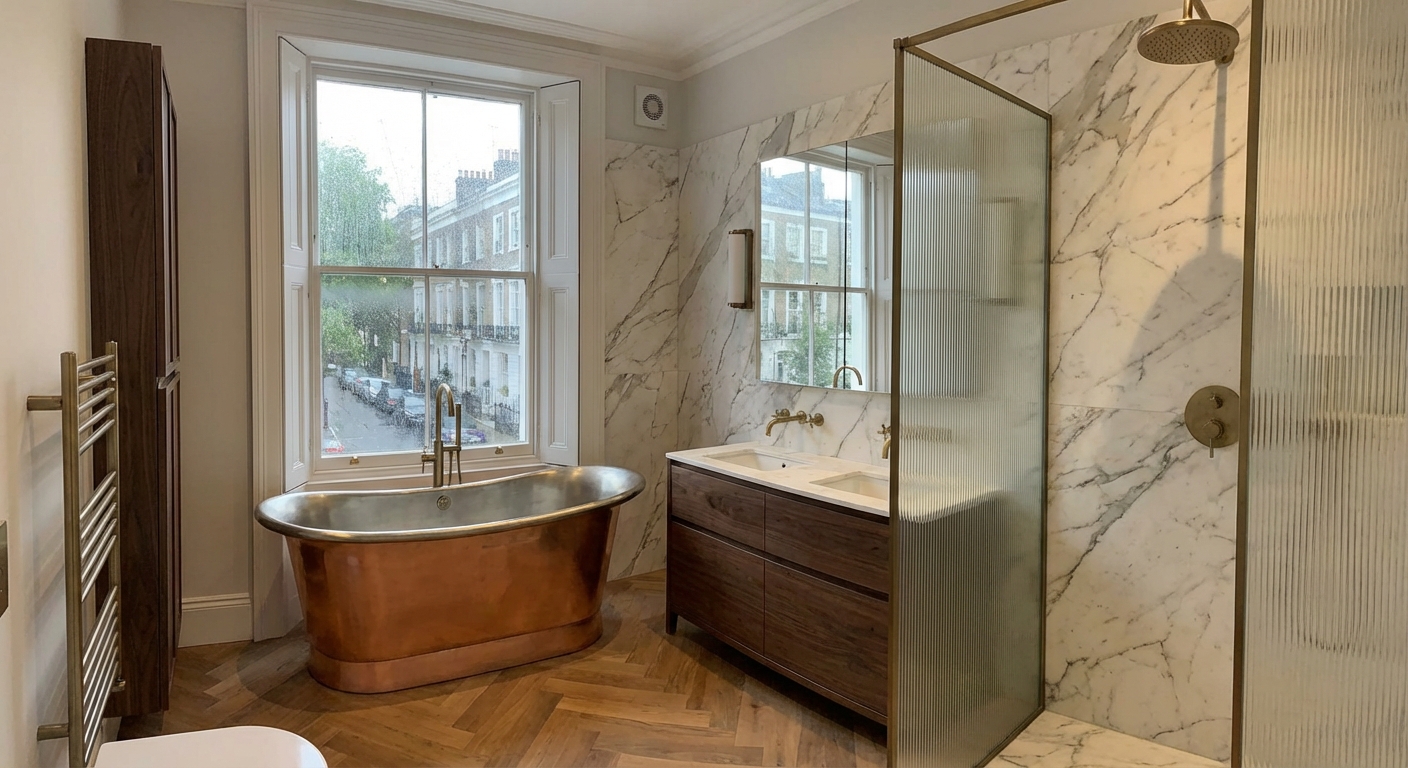
A bathroom renovation isn't just about new tiles and a fresh suite. It's about fixing the problems you've been living with — the shower that dribbles, the cold floor at 6am, the toilet that's too close to the wall, the mould in the grout that keeps coming back no matter how much you scrub. A proper renovation addresses all of it: plumbing, ventilation, waterproofing, layout, and finish.
We renovate bathrooms across the UK, from compact en-suites in London flats to family bathrooms in Manchester semis and luxury wet rooms in Bristol townhouses. Every project is different, but the approach is the same — strip it back, fix what's behind the walls, and build it right so it lasts 15–20 years without issues.
The most expensive bathroom renovation is the one you do twice. We see it regularly — homeowners who hired a general handyman, skipped the waterproofing, and ended up with water damage to the ceiling below within two years. Our bathroom builds are properly tanked, properly ventilated, and signed off where building regulations apply. We do it once, we do it properly.
What Makes a Good Bathroom?
Three things: layout, waterproofing, and ventilation. Get those right and everything else follows.
Layout is about making every centimetre count. A well-planned 4m² bathroom feels spacious. A badly planned 8m² bathroom feels cramped. We work through the layout with you — where the door swings, where the towel rail goes, how much clearance you have in front of the WC, whether the shower screen opens the right way. These details matter more than the tile you choose.
Waterproofing is what separates a professional job from a DIY disaster. Every shower area, every wet room floor, every bath surround needs proper tanking — liquid membrane or sheet membrane applied to the substrate before any tiles go on. Water finds gaps. If it gets behind the tiles, it rots the wall, stains the ceiling below, and you're ripping it all out again in three years.
Ventilation prevents mould. Approved Document Part F requires mechanical extract ventilation in bathrooms — a minimum extraction rate of 15 litres per second for a bathroom, 6 l/s for a WC. If there's no opening window, the fan must run on a humidistat or overrun timer. We install quiet, efficient fans as standard and make sure the ducting runs to the outside, not into the loft space (a common bodge that causes condensation problems in the roof).
Types of Bathroom Renovation
From a quick refresh to a complete reconfiguration, here are the main types of bathroom project we take on.
Full Bathroom Renovation
A complete strip-out and rebuild. We remove the old suite, tiles, and any damaged substrates, then re-plumb, re-wire, waterproof, tile, and install a new suite from scratch. This is the opportunity to change the layout — move the bath to a different wall, swap to a walk-in shower, reposition the WC. If you're planning to stay in the property for years, a full renovation is worth the investment. It's also the time to upgrade the pipework — many older homes still have 15mm supply pipes that restrict flow to modern showers.
Wet Room Conversion
A wet room removes the shower tray entirely — the whole floor is waterproofed and graded to a single drain point (linear or centre). This requires specialist tanking: a liquid-applied or sheet membrane covering the entire floor and up the walls to a minimum of 150mm (we take it higher — full wall height in the shower zone). The floor is built up with a screed that falls 1:60 to the drain. Wet rooms are ideal for small bathrooms (they eliminate the visual barrier of a shower tray), for accessibility (level-access entry for wheelchair users), and for a contemporary look. The tanking and drainage work adds £2,000–£4,000 over a standard renovation.
En-Suite Creation
Building a new en-suite where there isn't one — typically by partitioning off part of a bedroom, converting a large cupboard, or using space from a loft conversion. The main challenge is plumbing: you need access to the soil stack for the WC waste (110mm pipe) and hot/cold supply pipes. If the soil stack is on the other side of the house, running a new waste pipe at the correct gradient (1:40 minimum for a WC) can mean raising the floor or boxing in pipework. We survey the route before committing to a layout. En-suites typically need 3–4m² minimum: enough for a shower, WC, and basin.
Accessible Bathroom
Designed for people with mobility challenges, accessible bathrooms feature level-access showers (wet room style), grab rails, a raised WC (comfort height — 450mm vs standard 400mm), non-slip flooring, wider doorways (minimum 825mm clear opening), and space for a shower seat or wheelchair turning circle (1500mm diameter). We work to the guidance in Approved Document M and BS 8300. If you're applying for a Disabled Facilities Grant through your local authority, we provide quotes and specifications in the format they require.
Cloakroom & Downstairs WC
A downstairs WC is one of the most requested additions — and one of the smallest building projects that makes a big difference to daily life. A cloakroom needs as little as 1.2m × 0.8m (enough for a WC and small basin). The critical requirement is drainage: you need a soil stack or main drain within reach. If there isn't one nearby, we can connect to an existing ground-floor waste pipe using a macerator pump (from £800 fitted), though a gravity connection is always preferable. Ventilation is mandatory — a mechanical extract fan if there's no opening window.
Bathroom Renovation Costs in 2026
Bathroom costs vary enormously depending on what you're fitting and how much plumbing needs to change. Here's a realistic breakdown. All prices include VAT and labour.
Budget Renovation
£3,000 – £5,000
Like-for-like replacement with standard sanitaryware (WC, basin, bath or shower tray) from manufacturers like Ideal Standard or Roca. Basic ceramic wall tiles in the shower area, painted walls elsewhere. Existing plumbing positions retained — no layout changes. New taps, shower mixer, and accessories. Vinyl or basic ceramic floor tiles. This suits rental properties and bathrooms where the layout already works but the fittings are tired. Timescale: 5–7 days.
Mid-Range Renovation
£5,000 – £10,000
Full strip-out with some layout changes. Quality sanitaryware (wall-hung WC, countertop basin, thermostatic shower valve, frameless glass screen). Full-height wall tiling, porcelain or large-format tiles. Underfloor heating (electric mat — £400–£800 installed). Chrome towel rail, recessed lighting, and a quiet extract fan. May include moving the shower or WC position by up to a metre. This is where most homeowners land — a significant upgrade that'll last 15+ years.
High-End Renovation
£10,000 – £20,000+
Designer-level finishes. Walk-in or wet room shower with linear drain and full tanking. Natural stone or large-format porcelain tiles. Wall-hung furniture with integrated storage. Digital shower controls, rainfall showerhead, underfloor heating, heated mirror, bespoke vanity unit. Structural changes possible — moving soil stack, removing walls, replacing floor joists. Luxury brands: Duravit, Crosswater, Hansgrohe, Villeroy & Boch. Timescale: 2–4 weeks.
Wet Room Conversion
£8,000 – £15,000
The premium is in the preparation: removing the existing floor, installing a new graded screed to the drain, applying tanking membrane across the floor and up all walls, and fitting a linear or point drain. The tanking alone costs £1,500–£3,000 in materials and labour. Add underfloor heating (works brilliantly with wet rooms — the heated screed dries the floor quickly), quality tiles, and frameless glass panels. A wet room in a compact bathroom feels twice the size of a shower enclosure.
Common Add-On Costs
These items sit outside the main bathroom fit but frequently come up during a renovation.
Moving the soil stack: £800–£2,000
The single most expensive plumbing change. The soil stack is the 110mm vertical pipe that carries WC waste to the drain. Relocating it means cutting into the existing pipework, rerouting through the floor or wall, and connecting at the correct gradient. Avoid it if you can — but sometimes the ideal layout demands it.
Underfloor heating (electric): £400–£800
An electric heating mat laid under the tile adhesive. Running costs are low (a typical bathroom mat uses 150W — about 4p per hour). Adds 10–15mm to the floor build-up. Must be installed by a Part P registered electrician and connected to its own thermostat.
New window or obscure glazing: £400–£900
Replacing a single-glazed bathroom window with a new double-glazed obscure unit. Must comply with Part L (U-value 1.4 W/m²K or better). Often combined with a new trickle vent for Part F ventilation compliance.
Waste pipe rerouting: £200–£600
Moving a basin or shower waste to a new position. Smaller waste pipes (40mm) are easier to reroute than the soil stack. The gradient must be maintained (18–90mm fall per metre for 40mm pipes) or the waste will drain slowly.
Building Regulations & Electrical Safety
When Do Building Regulations Apply?
A straightforward bathroom renovation — replacing the suite, re-tiling, and fitting new taps — doesn't require a building regulations application in most cases. However, several elements within a bathroom renovation are governed by building regulations:
Part P — Electrical Safety: All electrical work in bathrooms must comply with Part P. This includes new lighting circuits, extractor fans, heated towel rails on dedicated circuits, and any alterations to existing wiring. The work must either be carried out by a Part P registered electrician (who self-certifies) or inspected and signed off by building control. Non-compliance is not just a safety risk — it can invalidate your home insurance and cause problems when selling.
Part F — Ventilation: Bathrooms require mechanical extract ventilation with a minimum extraction rate of 15 litres per second (or 6 l/s for an intermittent fan running on a 15-minute overrun). If the bathroom has no opening window, the fan must run continuously at a trickle rate or be connected to a humidistat. The duct must run to an external wall or through the roof — never into a loft space, which we see on poorly done conversions all the time.
Part G — Sanitation: Hot water must not exceed 48°C at bath outlets (thermostatic mixing valves are required). WCs must connect to a soil stack or be served by a macerator that meets the appropriate British Standard. All waste pipes must be properly trapped and vented.
Structural changes: If you're removing a wall, altering floor joists, or creating a new opening, Part A (Structure) applies and you'll need structural calculations. This is common when creating an en-suite from a larger bedroom or combining a WC and bathroom into one room.
Electrical Zones in Bathrooms
Bathroom electrical installations are governed by BS 7671 (the IET Wiring Regulations), which defines zones based on proximity to water sources. Understanding these zones affects what fittings can go where:
Zone 0: Inside the bath tub or shower tray. Only SELV (Separated Extra Low Voltage) equipment at 12V maximum can be installed here. IP rating IPX7 (protected against immersion).
Zone 1: Directly above the bath or shower tray to a height of 2.25m from the floor. Fixed electrical equipment rated at least IPX4 (splash-proof) is permitted — this includes electric showers, instantaneous water heaters, and fixed luminaires. 240V is allowed for permanently connected equipment but not socket outlets.
Zone 2: Extends 0.6m horizontally beyond Zone 1, and the area above Zone 1 up to 3m from the floor. Shaver sockets (complying with BS EN 61558-2-5), luminaires, and extractor fans with a minimum IP rating of IPX4 are permitted. Heated towel rails and wall heaters can be installed here with appropriate IP ratings.
Outside zones: Standard electrical fittings are permitted, but all bathroom circuits must have 30mA RCD (Residual Current Device) protection. This applies to existing circuits too — if you're renovating and the existing circuits don't have RCD protection, we upgrade the consumer unit to include it.
We coordinate all electrical work with our Part P registered electricians. Every bathroom installation receives a Minor Electrical Installation Works Certificate (or an Electrical Installation Certificate for new circuits), which you should keep with your property records.
Getting the Details Right
Waterproofing & Tanking
Tanking is the process of creating a waterproof barrier between the tile surface and the substrate (plasterboard, cement board, or masonry). Water will eventually get through grout joints — it's not a matter of if, it's when. The tanking membrane behind the tiles is what actually keeps your house dry.
For standard shower areas, we apply a two-coat liquid tanking membrane (products like BAL Tank-It, Mapei Mapelastic, or Schlüter DITRA) to the walls and floor of the shower zone. Each coat is applied with a roller and reinforcing tape at joints and corners. Total thickness is 1–2mm, but it provides a continuous, flexible waterproof barrier.
For wet rooms, tanking is more extensive. The entire floor is tanked with a sheet membrane or liquid-applied system, taken up the walls to a minimum height of 150mm (we go full height on shower walls). The membrane must integrate with the drain unit to create a seamless waterproof envelope. We use systems from Impey, Schlüter, or Marmox that come with manufacturer warranties of 10+ years when installed to their specifications.
Common tanking mistakes we see on remedial jobs: using standard plasterboard in the shower zone (it disintegrates when wet), not taping joints in the membrane, and running the membrane under the shower tray instead of around it. We use moisture-resistant boards (cement board or tile backer board) behind all tiled areas, not just the shower zone.
Underfloor Heating Options
Underfloor heating in a bathroom is a genuine comfort upgrade, not a luxury. Cold tiles underfoot at 6am are miserable. There are two options:
Electric mat systems (£400–£800 installed): A thin heating mat (typically 3mm) laid on top of the subfloor, embedded in the tile adhesive. Powered by a dedicated circuit with a thermostat (usually a programmable type set to warm up 30 minutes before your alarm). Running costs are modest — a 3m² bathroom mat draws about 150W, costing roughly 4p per hour at current electricity prices. Ideal for renovations because the mat adds minimal height to the floor build-up.
Wet underfloor heating (£1,200–£2,500 installed): Warm water pipes embedded in a screed or routed through the floor joists. More efficient than electric but significantly more disruptive to install — the floor needs to be raised by 50–75mm for the screed, or the joists need routing (which affects their structural capacity). Only practical if you're already fitting wet underfloor heating throughout the house, or if the bathroom is part of a new build where the floor is being laid from scratch.
Soil Stacks & Waste Plumbing
The soil stack is the 110mm vertical pipe that carries waste from WCs to the underground drainage. Its location dictates your bathroom layout more than anything else. Moving a WC more than about 1.5m from the stack requires extending the waste pipe, which must fall at a gradient of 1:40 (18mm per metre minimum). Over longer distances, this gradient can mean the waste pipe drops below floor level, requiring either a raised floor or routing through the ceiling of the room below.
Relocating the soil stack itself is a major piece of work: £800–£2,000 depending on the route. It involves cutting into the existing stack, running new 110mm pipework to the new position, and reconnecting all branch pipes (basin, bath, shower) to the new route. If the stack vents through the roof, the roof penetration needs moving too. We always exhaust every layout option that avoids moving the stack before recommending it.
Basin and shower waste pipes (40mm) are much easier to reroute. They run at a gradient of 18–90mm per metre and can often be concealed within the floor void or a stud wall. If you're on a concrete slab with no floor void, waste pipes either run along the wall surface (boxed in) or need to be chased into the slab — which is doable but adds cost (£300–£600 per route).
Ventilation Requirements
Mould in bathrooms is almost always a ventilation problem, not a heating problem. Approved Document Part F sets the requirements:
Bathrooms with opening windows: Intermittent extract fan rated at 15 l/s minimum, with a 15-minute overrun timer after the light is switched off. The window provides purge ventilation; the fan handles the moisture while the room is in use.
Bathrooms without opening windows (internal): Continuous extract at a trickle rate (8 l/s minimum) or intermittent extract at 15 l/s with a humidistat that keeps the fan running until humidity drops. A humidistat-controlled fan is the gold standard — it responds to actual moisture levels rather than a simple timer.
Ducting: Must run to the outside — through an external wall or up through the roof. We use rigid or semi-rigid ducting (never flexible foil, which sags, collects condensation, and restricts airflow). The duct should be insulated where it runs through cold spaces (loft) to prevent condensation forming inside the duct. A backdraught shutter at the external termination prevents cold air blowing back into the bathroom.
Fan selection matters. Cheap axial fans push 80–100m³/h but are noisy (40+ dB). We fit centrifugal fans rated for longer duct runs (up to 3m rigid duct), which are quieter (25–30 dB) and more effective. Brands like Vent-Axia Silent Fan, Envirovent, and Greenwood are what we specify.
How a Bathroom Renovation Works
From the first survey to turning on the underfloor heating, here's how the project flows.
Design & Survey
1–2 weeks. We measure the room, check the soil stack position, water pressure, electrical supply, and floor structure. You choose your suite, tiles, and finishes. We produce a dimensioned layout drawing and a detailed quote. Materials are ordered — allow 1–2 weeks for delivery, especially for special-order tiles or sanitaryware.
Strip-Out & First Fix
2–4 days. The old bathroom is stripped to the shell — suite removed, tiles hacked off, old plumbing and electrics disconnected. We assess the substrate condition (checking for damp, rot, or inadequate boarding). First-fix plumbing reroutes pipework to the new positions. First-fix electrics runs cables for lighting, fan, underfloor heating, and towel rail.
Build & Finish
5–14 days. Boarding, tanking, underfloor heating mat, and tiling. Grout and silicone sealant. Second-fix plumbing connects the suite, shower valve, and taps. Second-fix electrics connects the fan, lights, heated towel rail, and thermostat. Final clean, snagging check, and handover. We test every connection, check for leaks, and commission the underfloor heating before you use the room.
Other Services You Might Need
Bathroom renovations often tie in with larger projects. Combining work saves on setup costs and reduces overall disruption.
House Extensions
Adding a bathroom to a new extension? We design the plumbing into the extension build from the start — it's far cheaper and easier than retrofitting after the walls are up.
Loft Conversions
Every loft conversion needs an en-suite or at least a WC. We build the bathroom as part of the conversion project, routing plumbing through the existing airing cupboard or running new risers.
Garage Conversions
Adding a shower room or WC to a garage conversion transforms it from a basic room into a self-contained space — ideal for home offices, guest suites, or annexes.
Full House Renovations
Renovating the whole house? We coordinate bathroom work with kitchen fitting, rewiring, replumbing, and decoration so everything happens in the right order with minimal waste.
Bathroom Renovation Questions
Common questions from homeowners planning a bathroom renovation. If yours isn't answered here, get in touch — we're happy to help.
Common Questions
Details regarding our process, planning constraints, and project timelines.
Request a Consultation
Tell us about your project requirements to initiate a detailed estimation process.
Ready to transform your property?
Partner with Doherty Builders for structural excellence and refined finishes.
Start Your Project